Inspiração
25/06/2026

People see teams defusing bombs, running a kitchen under pressure or pulling a truck together. They see the action, the adrenaline, the high point. What they rarely see is what happened before. And that is exactly where an Immersis experience begins.
At Immersis, we start with the right question.
When a client comes to us, they rarely arrive with the final framing of the problem. They ask for a different activity, something memorable, a solution that brings energy, connection and impact. In many cases, that request is legitimate. But the first conversation is not meant to choose an experience from a catalogue. It is meant to understand what is really happening inside that team.
We want to know where collaboration is stuck. Which tension is draining clarity. Which conversation never quite happens. Which pattern keeps repeating even though everyone already knows it costs time, trust and focus. The entry point may be an event, but the work begins when we stop talking only about format and start talking about behaviour.
The questions are simple, but rarely comfortable. Where are you losing energy? Which silos are still being protected? What happens when pressure rises? What kind of leadership appears when no one has all the answers? In many organisations, the wound appears disguised as a logistics issue, a team climate problem, low motivation or lack of alignment. Underneath, we almost always find a more concrete tension: slow decisions, fear of making mistakes, excessive control, teams that communicate a lot and understand very little, cultures that speak about autonomy while rewarding dependency.
Harvard Business Publishing, in its 2025 global leadership development study, describes the growing pressure to create learning that is faster, more fluid and more future-ready. In the field, that confirms an intuition that has guided us for years: before designing an experience, we need to understand which situation the organisation needs to rehearse. Without that diagnosis, the experience may be memorable, but it will rarely be transformative.
Tension needs to take shape
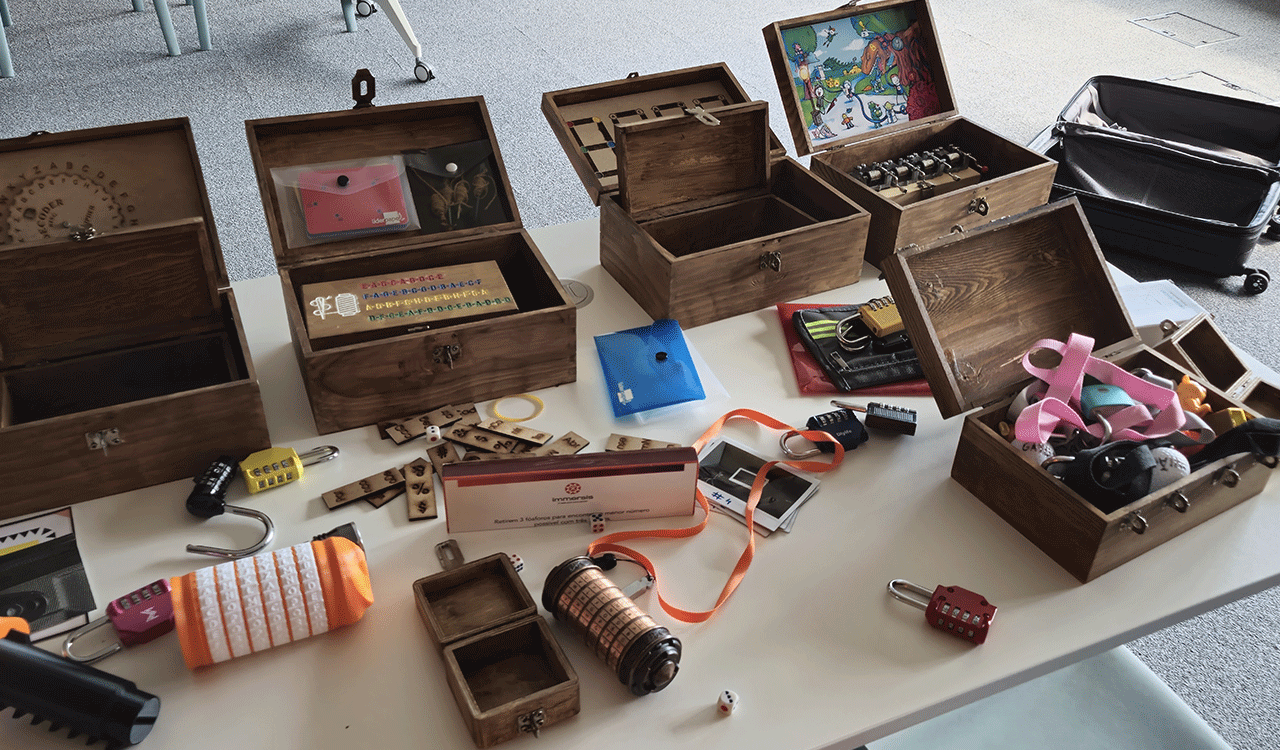
After the diagnosis, we move into the studio. This is where the invisible starts to take form. Whiteboards, sticky notes, arrows, prototypes, pacing, turning points, narrative hypotheses and decisions about the type of pressure we want to create. The process looks more like a writers’ room than a traditional training preparation.
This happens because designing an immersive experience requires translation. A sentence such as “our teams do not collaborate” needs to become a situation where collaboration has consequences. A complaint about excessive control needs to become a challenge where trying to control everything slows the result down. A communication problem between functions needs to appear in a context where withheld information prevents the team from moving forward.
This is where experiences such as Bomb Squad, Restaurant Takeover, Blind Driving or Truck Pulling stop being just formats and start working as pedagogical devices. In Bomb Squad, for example, information may be fragmented and the team can only progress if it creates a clear communication system under pressure. In an experience inspired by a professional kitchen, leadership, coordination and service become visible when pace rises and error leaves a mark. In Truck Pulling, physical effort reveals what many teams over-rationalise: no one pulls alone, and progress changes when direction, cadence and trust are aligned.
The experience gives the problem a body. It removes it from discourse. It places it in the hands, voice, time, movement and choices of the team.
The visible experience rests on invisible architecture
The 2026 Udemy Business report reinforces a clear trend for anyone working in L&D: organisations are looking for learning that is more applied, closer to work and more useful in demanding contexts. That makes design decisive. The client team may only see the final moment, but everything that happens in that moment has been prepared to generate behavioural evidence.
On the eve of an experience, the production team is calibrating much more than a set. Light, sound, time, instructions, difficulty, technology, safety, emotional rhythm and margin for error are all adjusted. A challenge that is too simple becomes entertainment. A challenge that is too difficult creates resignation. The right point creates involvement, friction and learning.
We also prepare the facilitators’ eye. What should be observed? Which patterns may appear? Where is the team likely to lose clarity? Who tends to take space? Who tends to disappear? Which moment will reveal the quality of communication? Every detail in the design exists to make visible a part of the system that usually remains hidden in daily work.
The debrief turns adrenaline into learning
The experience generates raw material. The debrief gives it meaning. Without this moment, the team leaves with an intense story to tell. With a strong debrief, the story becomes awareness, shared language and commitment.
The questions we ask after the experience rarely seek polished answers. They seek truth. What happened when time started to run out? Which information got stuck? Which decision took too long? Who took formal or informal leadership? Which pattern from this simulation already exists in real work? What is worth repeating? What needs to change?
McKinsey has argued in recent materials on learning and the future of work that effective learning needs to be integrated into real context and connected to continuous adaptation. The debrief is the bridge between the intense moment and the following Monday. It is where the team stops talking about collaboration in the abstract and starts recognising how it collaborated when it truly needed others.
That is why an Immersis experience does not end with applause, a photograph or a spontaneous comment that “it was fun”. It ends when the team can name what it learned and choose what it will do differently at work.
What the client sees is only the tip of the iceberg
When participants arrive, they find a stage that is ready. There are materials, technology, narrative, prepared facilitators and an experience that seems to unfold naturally. What they do not see are the weeks, and sometimes months, of invisible architecture that made that moment possible.
They do not see the diagnostic conversations, the failed prototypes, the rewritten questions, the rhythm adjustments, the technical tests, the safety decisions, the internal conversations about the emotional curve and the careful choice of the right experience for that specific tension.
A transformative experience is built. It begins before the event and continues after it. Its value lies in the way it makes visible what the team needs to face and in the quality of the bridge it creates to real work.
If your organisation senses there is a team challenge that another workshop will not solve, the starting point may be a diagnostic conversation or an OpenLab. That is where we stop talking only about activities and start designing change.
We do not promise ease. We promise truth.
And Nothing will ever be the same.
Fonts: